Death Stranding 2: The Unseen Canyon Carving Gaming's Future
Death Stranding 2 masterfully blends stunning visuals, seamless gameplay, and innovative tech, redefining next-gen gaming with immersive storytelling and boundary-pushing graphics.
When I first booted up Death Stranding 2: On The Beach, I expected visual splendor—a given after its predecessor's haunting beauty. But as I trekked deeper into its desolate yet mesmerizing world, something shifted. This wasn't just another pretty face; it felt like discovering a hidden cave painting that rewrites history. You see, next-gen games often dazzle early in a console's life cycle—Demon's Souls for PS5 or Killzone for PS4—but true boundary-pushing emerges later, like wine aging past its initial ferment. Death Stranding 2 arrives precisely at this inflection point, weaving technical wizardry with narrative chaos in ways that left me reeling.
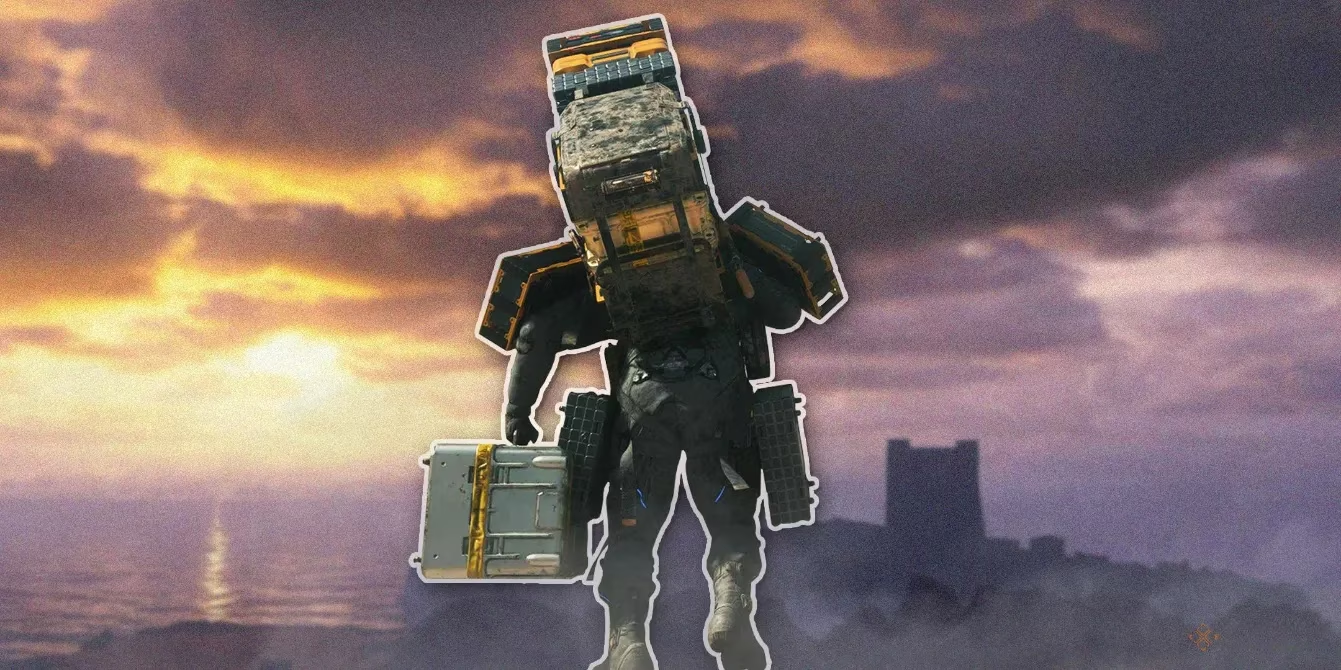
Take the opening moments: Woodkid's Minus Sixty One swells as Mexico's jagged hills unfold before me, each rock face rendered with such obsessive detail it’s like watching a glacier breathe—slow, monumental, and terrifyingly alive. I spun the camera, half-expecting seams or pop-in, but found only silence and seamlessness. Hideo Kojima’s team didn’t just build a world; they crafted a diorama under glass, where every grain of sand holds weight. And yes, in true Todd Howard fashion, if I spied a distant peak, I could stumble toward it, boots crunching on virtual soil. Yet this freedom isn’t the real marvel.
No, the fireworks came later. Chapter 5’s Day of the Dead sequence erupted around me, a cacophony of sparks and pinwheels dancing like drunken fireflies in a hurricane. Thousands of particles collided—bouncing off Sam’s coat, fizzling into puddles—while neon-lit crowds blurred into the chaos. It’s Kojima Productions flexing, sure, but also whispering: This is what’s possible now.
Beyond visuals, the game’s loading times floored me. Thirty hours in, menu transitions still feel like snapping fingers—one second flat, as fleeting as a hummingbird’s wingbeat. That’s not just convenience; it’s sorcery, eliminating friction between player and immersion. Other feats sneak up too:
-
🌌 Dynamic weather systems where rain slicks rocks like melted obsidian
-
🎭 Facial animations so nuanced, characters emote through eyelid flutters
-
📦 Physics-driven cargo that tumbles downhill like clumsy marmots
All this runs on Guerrilla’s Decima Engine, the same backbone behind Horizon Forbidden West—a game I once crowned this generation’s visual king.
But Death Stranding 2 redefines the engine’s limits, stretching it like molten glass into new forms. Decima’s evolution? It’s less an upgrade, more a river carving a canyon—each iteration deepening grooves others might never touch. Originally forged for Killzone, shared between studios like a sacred torch, it now births worlds where fire and shadow dance in real-time harmony.
I wonder… what does this mean for others? If Decima can birth both Horizon’s lush jungles and Death Stranding’s bleak shores, could it become gaming’s Rosetta Stone? Sony’s tight grip may limit access, but the blueprint’s out there—a challenge thrown at every developer staring at dated tools.
Maybe we’re witnessing a quiet revolution. Death Stranding 2 doesn’t just set bars; it melts them down, pours them into molds we’ve never seen. And as I stand here, watching sparks kiss Sam’s shoulders, I can’t help but itch for Horizon’s next chapter. If this engine keeps flowing, what new canyons will it carve?